Ministry logo

Ministry logo
Showing posts with label curators. Show all posts

Wednesday, 13 June 2018

The Battlefield of Exhibition Design


There’s a battle going on behind the scenes of museums and its taking place in project meetings across the world. Collections staff are having to harness their collection management toolkits, arm themselves with knowledge of off-gassing, lux levels and accurate RH and temperature readings. All in the good name of best practice in collections management.

The Times recently published ‘Amanda Levete begs V&A’s curators to see the light and feel the drama’ and it documents an all too familiar battle that collections management face with architects, designers and any creative minds who do not appreciate the duty of care museums need to take to preserve collections for future generations.

The Times article outlines the development of the  ‘occulus’ in the redeveloped courtyard of the V&A – a skylight that would ‘bring light to the historic collections’ (nah mate)  and allow the public to view into the galleries below - if curators weren’t such cowards apparently. For any collections staff it’s an infuriating read that of course sympathises with Levette.
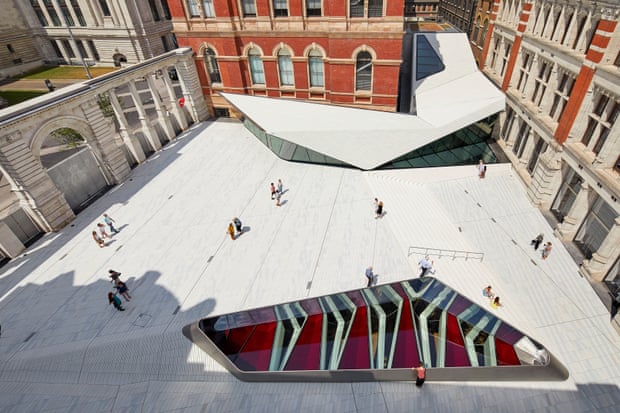
The Occulus @ V&A Photo: Guardian

The article goes on to claim that curators are conventional and terrified of daylight and thus have used black out blinds to block out the scary sunlight since opening.  Levette’s team had calculated that the light would fall down eighteen every hour of every day in every year . Yep - you heard right. Every. Single. Minute of every single day light would be falling onto the collections. And naturally the article takes no counter argument or consideration to collections care into account, - there wouldn’t be an issue with daylight falling onto the collections for 18 hours a day – nothing would happen right?

The curators are far from cowards and should be highly commended for sticking to their point and pull down the blinds on such risks to their collections. Indeed, I'd say its a win for collections management everywhere to see a curator who is so clearly on-side with the conservation staff. 

But this battle is not one that the V&A face alone, having spent much time working on exhibitions I’ve heard all of the ‘innovative’ and ‘striking’ ways we should put our collections at risk for the sake of a creative display. It doesn’t matter how many times you pass on collections display guidelines, barrier lengths and glass thickness details designers and architects will still come back with some crazy way of putting their concept first and the museum collection last – in my time I’ve heard of smoke machines in galleries (nope) the all too common staking objects on top of one another (definitely not) and the enraging ‘does it really need a barrier?’ 

How do we overcome it and continue to ensure collections are put first?

Voice your concern – if something doesn’t make sense on a drawing or a design briefing, ask about it! Often designers will have examples of similar displays, ways of mitigate risk or quite simply some ingenious and sneaky way of displaying objects safely and securely.

Assess the risk – if you really think that the collection is at risk and the designers aren’t budging then do a collections risk assessment, outline the eventualities and how the collection can be affected – this can serve as a good midway point to the argument. If there’s too much of a risk can a facsimile be made?

Stick to your guns – Hold your own and don’t be bullied into stepping down, there is a certain amount of creative thinking that can be discussed in early design plans but if ultimately the object is at risk and documented then don’t let it happen. Speak to colleagues in other museums and see how similar projects but remember as collections carers the objects come first.

Put the challenge over to them - Designers are brought on to projects to bring their experience, expertise and problem solving skills. They also work for the museum, who is the client. Challenge them to come up with innovative solutions that work within the environmental conditions you require. The design process should always be a conversation! 

And  finally! 

 Remember the goal - All parties are working towards the same aim a great display and an increase in access to our wonderful collections! 


Sunday, 14 January 2018

Welcome to Purple Glove Club

Do you get a pang of anxiety every time you see a museum promo shot with white cotton gloves? Do you scream at the TV as the 'historian' dons the expected uniform?  We're got the ultimate solution to all collections management problems (well sort of) - introducing the Purple Glove Club! 


The misrepresentation of collections management goes deep into societal ideas of a museum (you know we love to chat about this!). Nope, we’re not all curators, we don’t know everything about every single thing event in history, we don’t know how valuable your Great Nan's vase is, our great institutions are certainly not dusty (*nods to Mark Carnell) and we definitely don't wear white cotton gloves all the time!  

On TV, in newspapers, social media and even in our own institutions the need to wear those impalpable protectors serves little purpose but to signify to the general public that we are handling something precious. They are the favourite accessory of the PR person or journalist, and all of us have been in those uncomfortable photo shoots in which we are forced to wear the white gloves because 'people like them'. Well, people like them because it's what they are told to like. We are ready to dispel the myth and celebrate a bit of purple nitrile.

First, we start with the basics - why do we even need to wear gloves? Yes, this is a question museum people get asked - can't you just do away with them entirely? Especially if its a TV presenter who wants to handle an object. If you don’t already know then head over to this great E-learning tool from Museum of London website.  Every object is different and while they need to be handled carefully in all instances the approach to handling can be diverse so while most objects need to be handled with gloves some just need a clean pair of careful hands or in some (now rare) cases white cotton gloves can be used. 

       @SRSRenSoc     
What's got our gloves in the twist is a thing we like to call the Mickey Mouse problem - getting our collections management hands into Disney costume ready for a show with pristine white cotton gloves. Predominantly the only time we’ve had to use white gloves is for handling photoshoots – in one job I even had a clean pair in my drawer for such occasions! While contorting yourself into an ‘object handling’ pose is a fake representation of museum work so are the cotton gloves. Collections management is a science and we use the gloves you might expect to see in a laboratory or a hospital. The difference between the stereotype of a frazzled, amateurish, secretive curator and a highly experienced museum collections professional can all be boiled down to the hands (and indeed, that's often all you see in photos of museum workers). 

It took several hours to get this shot 
But what is wrong with white gloves I hear you say? We’ll here’s our top three reasons why they are not always suitable: 


1) Can you feel it yet? The density of cotton makes it a bit more difficult to get your hands around an object without a good grip they can slip straight out of your hands (Remember the first time you broke an object?) And no press photo shoot is improved by the object in question getting smashed.

2) Wanna get dirty – you know how sweaty you get on install? Yep, imagine all of that sweat building up onto an absorbent fabric and coming through onto the object (eww). Plus they tend to look pretty dirty pretty quickly - again, not exactly great for your museum brand. 

3) Hazards bingo! If you think all that sweat can make its way out, what can make its way in? Yep, all of our favourite museum hazards can seep into your pores! It doesn't really matter how short a period you are holding the object for - even if its just for a few photos, it's not something we want to risk our lives over! 

If that’s not enough to make you want to go nitrile then ask your favourite conservator their thoughts – there’s plenty more!
  
But why nitrile?  Well my friend, they are durable, tactile non-absorbant and looks pretty freaking good with any outfit. We feel safe, the objects stay safe, conservators are happy, curators are happy - all that's left to do is spread the word! 

Purple gloves they may make you a bit clam-y but...

They look good with any outfit 

Even when they clash with your hair 
Credit: C John Chase

It took a whole day to rip these bad boys up!
They are super bright and cheerful 

They are tactile and help us do our jobs better

They are durable and protective 

and they bring professional museum work into the twenty-first century!


So are you ready to join the #purplegloveclub? We’re calling for a revolution in museums and to celebrate the wonders that are purple nitrile gloves! The more we can make the representation of these gloves the standard, the sooner we can give the cotton glove conspiracy the boot! Share your photos on insta and twitter and be sure to tag us! 


Thursday, 11 June 2015

Why won't you respond to my email and other woes of academics

So here’s a bit of a spoiler for you – I (Kristin) am currently taking a break from museum work to do my PhD. And something I’ve found about being a museum professional in the academic world is that you are something of a unicorn. Everyone wants to hear about this mysterious ‘museum sector’ – who are these museum people? Where do they come from? How can I work with them? And most importantly, how do I get a museum job? At a panel at my university today, I was asked one of the questions I hear the most and one I think really deserves a full response. A fellow PhD asked me:

Do museums really want to help researchers if they are so busy and cash-strapped? If they really cared they would respond to my emails.


First of all can I just say, despite the reputation we might get from a handful of grumpy people, museums love, nay EXIST, to help with research and engagement. Please don’t get the impression that museums don’t want to help you, we do, and in fact if we are a national museum we legally have to. But your point about museums being busy and cash-strapped it well taken, and this, not any other reason, is why we take so long in replying.

That said, there are some things that academic researchers could do that will ensure you get the best response in the fastest time.
  • Please check the online catalogue first. If you email a question like: ‘I’m interested in Victorian pottery, what do you have of that?’ there is a pretty high likelihood that enquiry is getting dropped to the bottom of the queue. We aren’t there to do your research for you!

  • Then again, something like: ‘I’ve identified these three objects I’d like to know more about, plus anything else that comes to mind’ is fine.
  • That said, please please PLEASE include reference numbers in your emails. Museums look after literally thousands of objects and just saying ‘the 1850s textile from Burma’ is specific but likely not good enough. It helps us to send emails to the right person and keep track of the enquiry with a number.
  • Be realistic about the number of objects you enquire about. Please be sure you genuinely need to know about everything you are asking for – researching a huge object lists takes lots of time, especially if you only think you are really interest in one or two.

  • Similarly- do you really need to see those objects? Likely a picture will do and what you really want to see is the object file- the provenance. There’s no point in physically getting an object from an off-site store when really what you want to know is who owned it, collected it etc. Be sure to ask for the right thing.
  • Be polite. It sounds like the most basic one, but sadly often neglected. Yes it is (in a way) curators’ jobs to help you, but they are doing it on a tight schedule and budget, so be kind.


Although people may not realise it (and it may not always feel this way for museum people) but research requests are actually really important and helpful. Tracking the number of requests certain objects and files get can be important for funding bids for conservation or digitisation projects. In depth research on the collections by external sources can be an important resource that museum people just don’t have time to do. Theses and published articles can be a boon to showing a museum’s research impact and utility and often make their way into grants and annual reports. 

So since a museum is helping you out, be sure you share and share alike. Let them know when research you did using objects is being published and send them a copy. This goes in files to help future generations and can actually help the doors stay open!

Museums and academics have in the past had a fairly tense relationship, but we don’t think this has to be the case. If researchers understood how to work with museums, and remembered to pay it back in terms of research output, everything would be rosy. And maybe curators would be less grumpy about answering their enquiries… maybe.


);