Ministry logo

Ministry logo
Showing posts with label exhibition review. Show all posts

Wednesday, 15 February 2017

More than a pretty woman: Emma Hamilton at the NMM

We have been wanting to make it down to Greenwich to see the National Maritime Museum's Emma Hamilton exhibition for aaaages. I mean, the Guardian gave it a five star review, and we hear some of its text panels are being used as best practice examples at MA workshops. This is besides the fact that its an exhibition about a woman, a rare beast for a museum, and certainly for a maritime museum at that. That the NMM took up the cause of a woman who is famous for being Nelson's mistress is interesting, and one imagines a concerted move on their part to be a bit more innovative with their maritime history remit. Well, it worked. Emma is engaging and intimate, drawing you through the museum's beautiful new exhibition space with ease. Her journey through the political turbulence of the late eighteenth century is fascinating, you certainly leave having a better appreciation for the life of an extraordinary woman.


The exhibition opens with a quote from Lady Hamilton herself, 'I wish to show the world that a pretty woman is not always a fool'. That Emma was beautiful is abundantly clear throughout the exhibition. Indeed, her beauty was the source of her fame and meteoric rise to the upper echelons of the society. It was her nymph-like face which led her to become the muse of George Romney and ultimately a household name in Georgian Britain. Her beauty also got her into much of the trouble in her life. An affair with a gentleman which began in a brothel ended in her being pregnant. She struck a bargain with another aristocrat, Charles Greville, to look after herself and her child. When Greville tired of her, he literally passed her over to his uncle (if you were here I'd murder you and myself both- she wrote to Greville in a rage). Emma spent much of her life being treated as a commodity. But there is absolutely no doubt that she was a woman making the best of her circumstances. 


The exhibition has to toe a rather fine line as it tried to exonerate the historic impression that Emma was nothing more than a harlot who seduced Admiral Nelson into an adulterous relationship. While it is abundantly clear that Emma was charismatic and artistically challenging, late eighteenth century women simply didn't have the independence to be the kind of kick ass feminist hero museum-goers might like to hear about. Emma didn't really have a choice but to be 'looked after' by wealthy men, to give up her illegitimate children, to turn to prostitution when times were hard. The extent to which Emma had genuine feelings for some of the men in her life is a bit confusing- did she truly fall head over heels each time? Or was she more interested in looking after her position? The exhibition seems to suggest she was a passionate woman who truly did love her conquests. Her love letters with Nelson are particularly touching and sincere. 


Personally I was the most interested in the part of the exhibition related to Emma's time in the Neapolitan court during the Napoleonic wars. Having married the British Envoy to Naples, Emma became a close confident of the Royal Family, and in particular Queen Maria Carolina, who was also sister to Marie Antoinette. Emma's role as an intermediary between the Neapolitan Queen and the British Navy was crucial to the success of Nelson's battle of the Nile. Emma's political acumen is more difficult to communicate in an exhibition and its perhaps less enticing than her home making with Nelson, or her portraits by Romney. But to me, this is really the heart of the exhibition. Emma was beautiful yes, but she was also courageous and wanted to prove her worth to the highest levels of society. As Amanda Vickery comments in the exhibition, Emma was a woman who refused to be defined by class. 


The exhibition design I also have to say was flawless. Throughout it is full of thoughtful touches which recall the importance of the theatre to Emma's career. Indeed, it feels like walking through a luxurious theatre-set of Emma's life, and in one instance literally becomes that. I absolutely loved the rooms made to evoke her 'Paradise Merton', her home with Nelson, complete with flickering candle effects. Emma becomes much more than just an artistic muse, but a really living breathing person who was looking for love and some sense of stability. The display of Romney paintings is equally awe inspiring. 


The NMM's exhibition is nuanced and empathetic, and will leave you even more intrigued by the life and times of Emma Hamilton. While this isn't really the focus of the exhibition, I think Emma provides a fascinating sense of late eighteenth century society, weaving quack medicine, salon society, music halls, and political turbulence. She might not be quite a feminist icon by 21st century standards, but the exhibition certainly does her justice as an ambitious and determined woman in a complex world. This is Emma on Emma's terms. 


Emma Hamilton: Seduction and Celebrity is on at the National Maritime Museum until the 17th of April. 

Wednesday, 25 January 2017

Taking risks at the Wellcome's Making Nature

What is Wellcome’s Making Nature about? Usually with museum exhibitions the answer is either a famous artist or individual (Bowie, Lockwood Kipling, Rauschenberg) or a theme which can typically be summed up in one word (underwear, Modernism, maps, mental health). Making Nature is about, well, exactly that. The idea that nature is a construct manufactured by human action and, more specifically, museums. Pretty conceptual for an exhibition right? This perhaps why the Wellcome hasn’t received universally glowing reviews for this one (see for example this Guardian think piece). When you build a show on a concept, people can disagree. It’s probably why most museum’s don’t do it. But it’s also why ALL MUSEUMS SHOULD. Making Nature is the thought-provoking, risk-taking exhibition you’ve been waiting for from the Wellcome. And we love it.

Richard Ross, Muséum National D'Histoire Naturelle, Paris, France 1982 © the artist

If Making Nature had only been one room, it still would have been the best thing I’ve seen a museum do in ages. The first gallery had everything you could want from a gallery of art and science. Entitled ‘ Ordering’, the opening to the exhibition does a fantastic job of demonstrating how a museum can communicate a complex idea. The concept is just that, how humans have ordered the world. From the Bible to Linneaus to Bonnet’s ladder of natural being, humans have been trying to rationalize and categorize the world around them from day one. Archival documents are used to great effect – providing a sense of history and context, but without being too ‘this is a history lesson’. A poster of Juliana Pastrana, the Bearded Lady, asks us to consider what happens when something defies categorization. If you weren’t scared by the hidden taxidermy fox, you are lying. I genuinely jumped.

Roger Fenton, Skeleton of Man and of the Male Gorilla (Troglodytes Gorilla) II, c.1855 © Victoria and Albert Museum,

Making Nature is full of unusual display techniques, but they are all for a purpose. The idea that a curator has suggested this off the wall exhibition, conceptual design and someone said – yes we will support you in that, heartens me. We are not an industry that has to put out cookie cutter exhibitions. The Wellcome knew full well that putting taxidermy animals in unusual places (ie dead on the floor) would upset some people. But that’s kind of the point. The animals serve a dual purpose: to push you to think about conservation (there’s a reason why they’ve picked the examples they have cough badger) and to mix up the way we are used to viewing animals. Animals go in nice dioramas where they look like they are alive, right? Yeah but we made that. And that’s the point.

Richard Ross, British Museum, Natural History, London, England 1985 © the artist
I don’t want to go into every single detail and spoil the visit for you. Let’s just say, you’ll never look at Richard Owen’s ‘cathedral to science’ (aka the Natural History Museum) the same way again. Or the ZSL Zoo for that matter. But I did just want to say a few words about the last room about Postnatural History. It’s clear from the get-go that this room has been curated by someone different. The reliance on speakers to tell the narrative is a little jarring, and not all of the displays seem to fit in exactly with the theme as it explained in the room label. And while this was a bit off-putting for me at first, I’ll forgive it because its just so damn interesting. The Centre for Postnatural History is interested in how we are making new animals and purposefully modifying the natural world. From multi-coloured budgies to radioactive rodents to bacteria which has learned to say hello, are we looking at a nature which is no longer natural? The stories in this room are bizarre and somewhat frightening.

Transgenic mosquito (Aedes agypti), 2009, Pinned specimen © Center for PostNatural History

Making Nature is without a doubt challenging. It’s challenging to audiences who think they know about nature and how it works. Challenging to traditional exhibition design. And to be honest, morally challenging. Importantly, its self-reflective on the part of the museum community. How as we as institutions profoundly changed the way people understand nature, and in consequence, the way people use natural resources. It’s not going to be everyone’s cup of tea. Nature is about love not manipulation (oh please). As the parrots say, all nature ever did was love us, and how have we repaid them? Making Nature is what I hope museums are moving towards. Exhibitions that are complex, challenging, and invite comment. Something that moves beyond that one word catchy theme or celebrity subject. I can’t wait for Part 2!

Wednesday, 26 October 2016

Bedlam at the Wellcome Collection


The Wellcome Collection's blockbuster offering for thus autumn's exhibition season takes another look at the asylum. Riding on a tide of interest in mental health issues, and the perennially popular Victorians, Bedlam has proved, yet again, that the Wellcome's brand is thriving. From it's own custom twitter bot, to lectures, blogs and even a photo-booth (#spiritbooth)- Bedlam is accompanied by all the best public engagement that a museum can offer. But, is it a good exhibition? The Ministry is very conflicted...


Guys, it has taken us a long time to sit down to write this review. Bedlam has so many strong points about it that it feels unfair to say we didn't like it. However, it definitely has some iffy parts about it as well so its difficult to say that wholesale it was great. 


Let's just take for example the Madlove Asylum. The Madlove Asylum is an installation at the end of the exhibition which is clearly intended to be the piece de resistance. It's even screened off from the main gallery space just so that you don't get lured in by exciting drawings and the scale model and miss the rest of the exhibition. Madlove is a separate (Wellcome funded) organisation composed of artists who have worked with a number of mental health stakeholders, including certified patients, to create a new vision for what the asylum could be. Is it possible to go mad in a safe way? If you designed your asylum what would it be like? Visitors are asked. 


The installation is dominated by a brilliant blue landscape model doted with cheerful angular pink structures and golden furniture. The Madlove asylum is like a site-specific piece of art but inspired by people in inpatient hospital care for psychiatric issues. A running track, an artist workshop, a library and even a market garden make this designer asylum sound an idyllic place for anyone dealing with any kind of mental health issue. Visitors are even invited to take a way a small 'pocket asylum' where they can write themselves reminders for when things get tough.


The Madlove Asylum is so good in fact, it kind of feels like the Wellcome wanted to have an exhibition about it and everything else was built backwards. The inclusion of patient art from Bethlem Hospital in the nineteenth and twenteith centuries is interesting, but doesn't really seem to have the same kind of narrative purpose. Is it an exhibition about asylum history, or asylum art? Asylums in art? The first room about Bethlem hospital in the eighteenth century seems a bit like that boring introductory bit your teachers make you write. (Why are there so many pictures of a hospital in Belgium - isn't this meant to be about English asylums? Or is about the development of the asylum system generally?)

I think the real concern about Bedlam is that it is a very 'Wellcome' exhibition. The brand has become so confident in fact that their exhibitions are becoming well, a bit predictable. A catchy artistic intervention to start, a room of historic contextualization, a room which blends objects and art in an unexpected way, and then some artistic interventions to finish it all off. Even the small bits of the exhibition which were trying to provide some historic narrative about the development of asylum treatment in the UK fade a bit into the background, overshadowed by the need to make everything COOL ART ALL THE TIME.


Let's be very clear about one thing- we love the Wellcome. We love the gallery, we love the exhibitions, the Reading Room, the events. We love how they have changed peoples minds about what exhibitions can be. We really really love their social media and engagement. Empathy Deck (a twitter bot developed just got the Bedlam exhibition) is about the greatest thing ever, and leaves you fun little messages on your twitter throughout the day. It's a cross between CBT and an art-installation (seriously follow @empathydeck). Our worry is just that, in terms of the exhibition design, the Wellcome might be getting a little too comfortable with the formula that has brought them such success. But what made a Wellcome exhibition so exciting was its willingness to be different and original. Let's hope is stays that way! 


Wednesday, 25 November 2015

Getting cosy with academics: The Fallen Woman at the Foundling Museum

Across the sector there has been a trend towards greater involvement from academics in museums and museum exhibitions. Generally, we are a bit suspicious of this – as museum professionals we think those who have actually worked with collections and understand professional standards should be essential in all museum functions. So when we heard the Foundling Museum has opened an exhibition with art historian and academic Lynda Nead as its curator, we were curious to see how it would turn out. And we were pleasantly surprised by what we found…


We love the Foundling Museum. It’s one of those small London museums that just goes to show the fantastic diversity of institutions available in the city beyond the big names. Honestly, whenever I see those little tokens left by mothers giving up their children it makes me tear up. If you haven’t been, the museum is worth a visit just for their permanent display – which is beautifully curated and does an excellent job of blending the Foundling Hospitals long history with its current mission. We love their use of oral history and contemporary art responses in particular.


Head down to the basement to find their modest exhibition space. The Fallen Woman may not be big, but it packs a punch. First of all, while there isn’t much room for text, what is provided is intelligent and to the point. As one of the authorities on women in the Victorian public space, Nead is able to quickly summarise and relate the historical context of the exhibition. While I expected her academic background to mean the text went about over the visitor’s head, actually it was thoughtful and intelligent: clear without dumbing down. Of course it also helps that this isn’t an exhibition geared towards younger audiences so they have a big more wiggle room from a serious historical take on the subject matter.

Names of the women whose petitions were used in the exhibition
I was also pleasantly surprised at the mix of materials on display. While paintings and engravings come to the fore, photographs and archival documents also play a role. Actually, as a historian, Nead is able to acknowledge and integrate the paper-based tools of the trade of history alongside the art: something that specialist art curators often over look. The letters and applications of the women to the Foundling Hospital are how we know about the experience of the individuals who needed the Hospital most, so why should they not also be included?


A sound installation fills the entire gallery with an eerie whispering music. I had thought this was just for effect, but as you enter the last room you realise these voices actually serve a purpose. The work of sound art is intended to bring the voices of the silenced, forgotten women into the space, with actors reading from the historical texts in the cases before you. Some people are really critical about sound installations: what is it really providing aside from a slightly spooky effect. Personally I think it would have been more effective if you could actually hear what the women were saying, rather than just disembodied and jumbled up phrases. But the symbolism really works with the overall theme of the exhibition, and the accompanying music gets you in an open emotional space for viewing the art works.


Expecting to be critical of the exhibition, I was blown away with what Nead and the Foundling Museum team have been able to achieve. Sensitive, intelligent, and moving; The Fallen Woman demonstrates all the positive aspects of getting an academic historian involved in an exhibition, but clearly with some effective guidance from museum colleagues. Text is legible, clear, and aimed at the right level. Beautiful art works are mixed with fascinating historical documents. Plenty of big text print outs and further explanations are provided so you can get as involved with the subject matter as you like. And the sound installation adds an extra level to an otherwise quite small space. Fallen Women goes to show how well an exhibition can be done with an academic historian- bringing a detailed knowledge of the period as well as the variety of material culture that can be employed.  

The Fallen Woman is on at the Foundling Museum until the 3rd of January. 


Friday, 30 October 2015

Not for the faint of heart: MoL's Crime Museum

The Crime Museum at the Museum of London has to be one of the most hotly anticipated museum exhibitions of the year. From Resurrection Men to Sherlock Holmes, MoL seems to be building its brand on the curious and the slightly morbid. The Crime Museum (otherwise known as the Black Museum) is the Metropolitan Police's own collection of evidence from history of policing, stretching back to the end of the nineteenth century. This is the first time that their objects have been seen by the public. So - plenty of cache, but how does the real thing stack up?

The exhibition is divided into two sections which are meant to reflect the lay our of the actual museum within Scotland Yard. The first section is modeled on older drawings of the Crime Museum, complete with fireplace and old fashioned cases. A broad-sheet style information pamphlet guides you through. Note: if you do not pick up this information pamphlet you will be very very confused as very little text is included with any of these objects. As a historian - this is the stuff I came here for: death masks of Newgate prisoners, execution ropes, textile and hair samples from the Harley Street mystery, and the cunning ladder of the cat burglar Charles Peace. 


Somewhat controversially, there isn't much here about Jack the Ripper. To be honest, after seeing some Ripper objects from the Crime Museum at the Wellcome's recent Forensics exhibition I was quite looking forward to seeing them again. But on reflection, Jack has really had his day, and crime in London is so much more than that. A few examples of police appeals for information from the era should satisfy someone who is a Ripper-ologist. 


I couldn't help but wish that more space had been given to the nineteenth century section - which so effectively transports the visitor into the space of the hidden crime museum. But unfortunately this section abruptly ends as you enter into one large, violently orange space dedicated to the Met in the 20th and 21st century. On one side, themed displays cover topics like weapons, drugs, and counterfeits, while along the other, individual cases are given over to particular trials or crimes. 

Staring into what feels like an endless abyss of labels, one visitor near me commented 'Wow, this is not the exhibition for you if you don't like to read.' As astute a comment as they come. I felt tired before I even really got started. Coming from the first section where text was sparse, the rest of the exhibition felt like reading a book. But then again, trying to imagine how you communicate the basics of a case: who it was, what happened, why it is relevant to the history of crime or policing, it's a necessarily verbose affair. Critical as I might be of so much text, I can't really imagine a better curatorial technique. It's just a difficult subject matter.


Speaking of difficult. While I probably should have considered this when going to see an exhibition called 'The Crime Museum', it is a very disturbing experience. There is a really strong sense that many of the famous crimes were perpetrated against women. With case after case of horrifically murdered women, I actually felt glad to see some gangsters shooting each other up. Even the one case which features a female perpetrator, Ruth Ellis, you kind of feel for her. In 1955, she shot her ex five times after he kicked her in the stomach, causing her to lose her child. Ellis was the last women to be executed in Britain. This, displayed near a case showing the different techniques used for illegal abortion over the years, speaks strongly about the place of women in the 19th and 20th centuries.


The exhibition ends with terrorism- of course one the biggest threats to London and the Met in recent years. The cases on IRA bombings are interesting, and its certainly relevant to include modern policing work. Although for me, the section about the 7/7 bombings still felt a little too recent. Bizarre to think already this has become museum-ified history.

The Crime Museum is certainly not a romp through London's seedy history. Despite it's bright colours and sleek fonts, this is really a very serious look into crime and punishment in the metropolis. Not for the faint of heart or for those who don't feel like reading. An exhibition to be pondered and a slow pace, and maybe followed by a calming cup of tea!


The Crime Museum is on at the Museum of London until the 10th of April, 2016. Pre-booking strongly advised. 


Friday, 18 September 2015

A love letter to museums: Joseph Cornell at the RA

Art and I don't always get along. As more of a history, object-centric person, I can find historical portraiture a little so-so, and contemporary art baffling. But at our recent visit to the Royal Academy, I came across an art exhibition that was speaking my language: the collages of American artist Joseph Cornell. 

Who? you might ask. Well, if you are a bit of an art amateur you might anyway. I like to think I know a little something about modern art, but I hadn't come across Cornell before. I was blown away in the exhibition by the casual mentions of Surrealist greats like Max Ernst and Rene Magritte who Cornell not only admired, but knew! Cornell is famous for his assemblages in shadow boxes. This cut-and-paste art works brought together Victorian bric-a-brac, historic images, tiny objects, maps, and all sorts of other materials to create wonderful mini-sculptures. 

Cornell was fascinated by museums and cabinets of curiosities, and it shows strongly in this exhibition. Books carved into storage boxes, pharmacy cabinets, and extensive labelling all appealed to Cornell's (and my!) love of order and organisation. His piece 'Museum' even plays on this idea: it's a box of tiny scrolls which need to be opened to reveal the treasure in side; the opposite of a museum where everything is on display!

Aside from these more literal museum connections, the exhibition, and indeed Cornell's work, is a testament to the power of museums. I couldn't help but be reminded of the Museum Association's 'Museums Change Lives' initiative: they certainly changed Cornell's. Even though he lived his entire life in the general New York area, through museums, books, and maps, he was able to explore the world. Cornell's works feel like an adventure through space and time, from the Medici's to the plants and animals of exotic South America. Cornell's work reminds us of the importance of museums to expand our minds and have the world at our finger tips.

Wanderlust is only on for another week at the Royal Academy, so you'd better get down while you still can! Find our more info here.


Also - though we can't claim this will happen to you on our visit, look who we met!!! 

Monday, 18 May 2015

Homes for the Homeless: the experience of Victorian poverty

We have to be honest, we usually find ourselves at the Geffrye Museum only around Christmas time. And for this, we are ashamed. For on a recent visit on a sunny spring day, not only did we realise that the building and its gardens are glorious in the sunshine, but it's exhibitions and displays are fascinating all year round. On this particular trip we were there to see 'Homes for the Homeless: Seeking Shelter in Victorian London' exhibition because, well, you know how we feel about the Victorians. (We love them in case that wasn't clear). What we found was a thoughtful, beautiful designed, multi-faceted exhibition that brought home the realities of life in the nineteenth century city.

The Pinch of Poverty - Thomas Benjamin Kennington 1891
Why is it that we are so fascinated by the Victorians? I think there's something fascinating about being able to look back at history through the medium of photography- which seems so immediate and 'real'. I also think we recognise a lot of ourselves in them - their socialising, family life, businesses, travel, aspirations : the Victorians are really the birth of the modern age we are still living in. But for all of the exciting technical innovations and fabulous clothes, Victorian London was a place of poverty, illness, and a pre-welfare state which left most of the work of looking after the vulnerable to charity organisations.

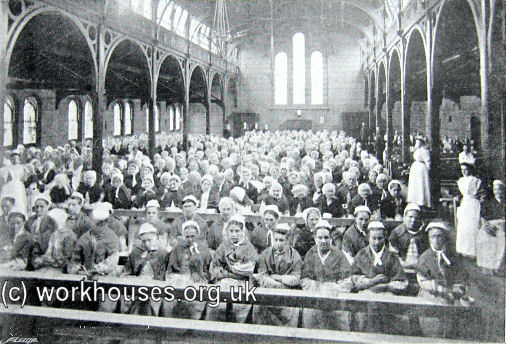
Meal-time at Holborn workhouse, 1885
We get pretty used to seeing images of Victorian families in slum conditions, dirty children playing in the street, or homeless people sleeping on benches. But we forget that for the homeless of nineteenth century London, they had to figure out everyday how to find a place to sleep and something to eat. How they achieved that shows the maze that was the Poor Law system (hospitals, workhouses), charity, and sometimes just sheer determination.

Corridor at a casual ward, early 20th c.
The Geffrye exhibition really aims to try and humanize all those black-and-white pictures of Victorian poverty that most of us have become desensitised to. Sure it's history, but those are really people's lives. Through recreated voice-recordings of contemporary testimonies, we hear about the experience of getting into a casual ward, living in a crowded common lodging house, or the best places to sleep rough. You can try the harrowing task of picking apart rope or sleeping in a coffin-like box bed. The displays show the savvy needed to navigate what relief was available, the conditions people endured, but also how people made the best of a bad situation.

Sleek, graphics-dense exhibition design
The messages of the exhibition are really hit home by a complimentary exhibition in the corridor in which vulnerable teens and children from the New Horizons Centre in Kings Cross. The participants reflect on their own experiences of homelessness, and see a surprising number of similarities with the situation as it was experienced over 100 years ago. With the new government possibly preparing to slash disability benefits, the Geffrye's exhibition takes on a new meaning as both a well-crated temporary display, and a meaningful warning for the future. 


 Homes for the Homeless is on at the Geffrye Museum until the 12th of July 


);