Ministry logo

Ministry logo
Showing posts with label #miniobjects. Show all posts

Monday, 9 March 2015

#miniobjects and the First World War

If there's one thing we love at the Ministry, it's hearing from 'behind the scenes' staff of museums. Conservators are particularly fascinating as they get to work hands-on with all the best stuff in the stores. We asked Louise Stewart Beck from the Science Museum to give us an insight into her favourite #miniobject...


Mini things are universally appealing. Proof: when I brought this object out of the stores, every one of the conservators in the lab crowded around to have a look. “It’s so tiny!” (About 8 inches long) “That’s not for babies, is it?” (It’s not.) “Then what’s it for?” Well, miniature versions of objects had a lot of purposes besides being entertaining. Small-scale objects are used to demonstrate proof-of-concept for new products and buildings, to gain an understanding of materials, or to carry around as sales models, since they’re more portable than the actual object. This model prosthetic was made by Alex Munro Armstrong of the Queen’s Own Cameron Highlanders, who lost his own leg in 1918 and probably based this model on his own leg. For the Science Museum, this model serves as an important research tool, demonstrating a type of prosthetic made at a certain point in time.


Louise Stewart Beck is currently a conservation intern at the Science Museum working on the First World War medical collections. She completed her master’s degree in Conservation at UCL last year. Follow her on twitter @LouiseSBeck

Wednesday, 4 March 2015

Guest Post! #miniobjects from Essex

Mini objects

Hannah Salisbury, Access and Participation Officer, Essex Record Office
I like things that are the wrong size, both giant things and miniature things, but here I am going to be focusing on the smaller end of that scale. As well as entertaining me, our smallest items can also entertain and interest our visitors and readers of our blog.
Tiny things can also of course present their own conservation and storage challenges; they are much more vulnerable to being lost, and need special looking after.
Here are two of the smallest things we look after at the Essex Record Office, which have both featured on our blog and have both had special packaging designed for them by our Conservators to help keep them that little bit safer.
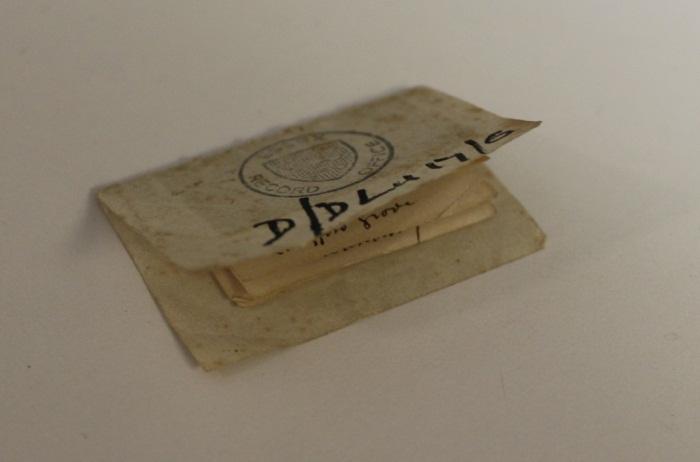
The first miniature document to feature on our blog was this one:
D/DLu 17/6 is definately very small.
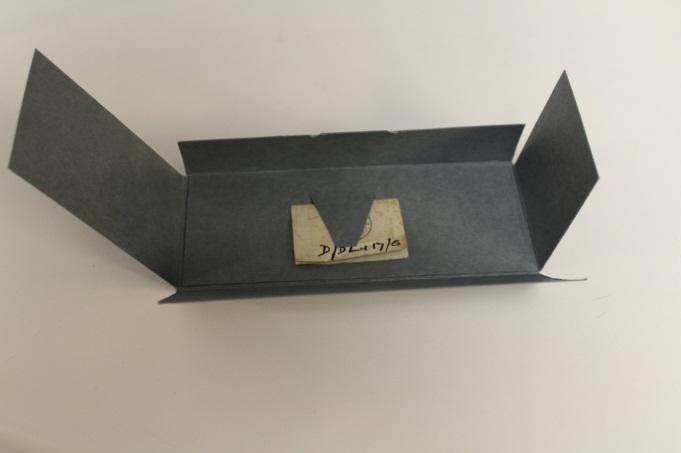
It measures just 36 x 26 mm and it now lives in a specially made folder that protects it and makes it harder to lose.
D/DLu 17/6 in its specially made folder.
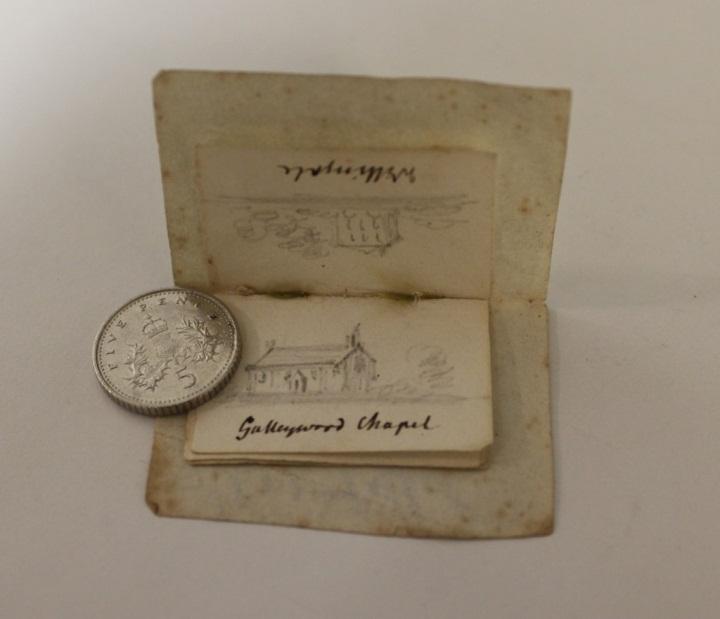
It is a tiny sketchbook containing miniature drawings of local places by Clarissa Sandford Bramston, wife of Reverend John Bramston from 1832 (vicar of Great Baddow, 1830-40; vicar of Witham, 1840-72; Dean of Winchester, 1872-1883). We don’t know exactly when the drawings were made but they must date to before 1844 when Clarissa died. Perhaps someone with a strong magnifying glass and an interest in Essex architecture may be able to suggest a date?
IMG_1095v
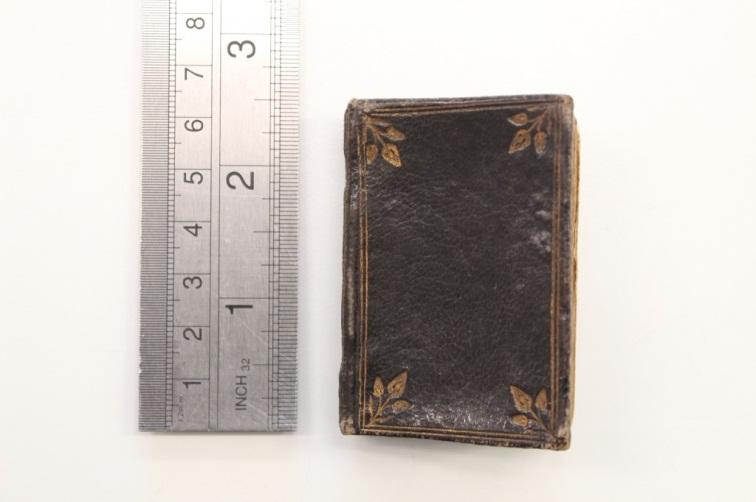
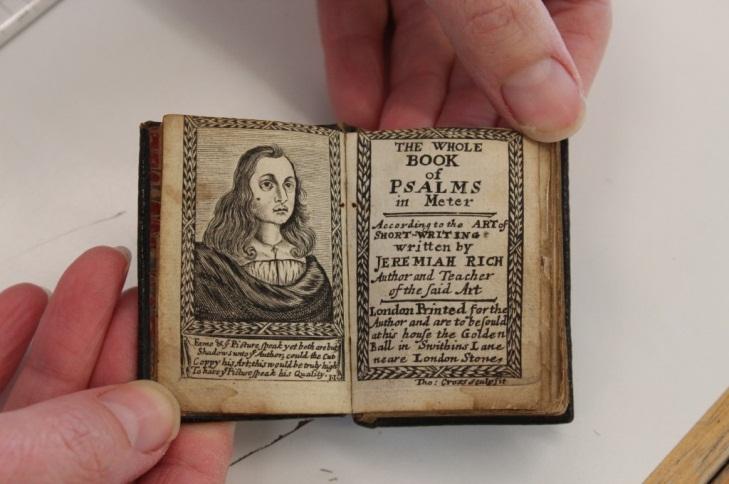
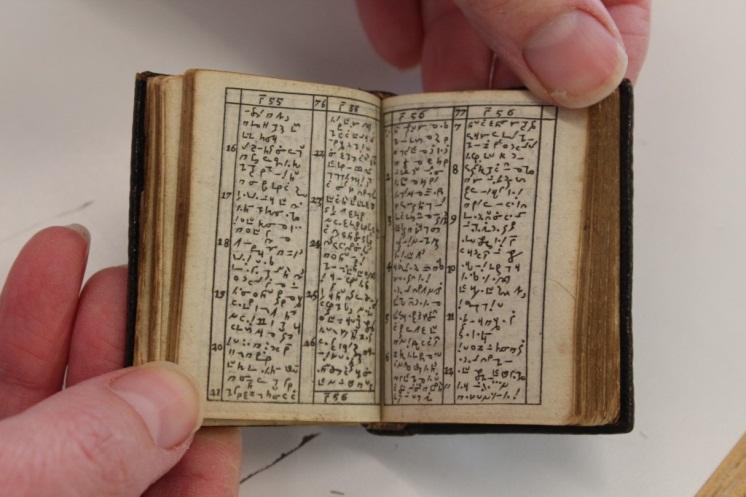
The next miniature item to feature on our blog may well be the smallest book in our collection. It is just 2.5 inches tall, and is seventeenth-century book of Psalms written in a kind of shorthand developed by a man named Jeremiah Rich.
IMG_5407


IMG_5411


IMG_5412


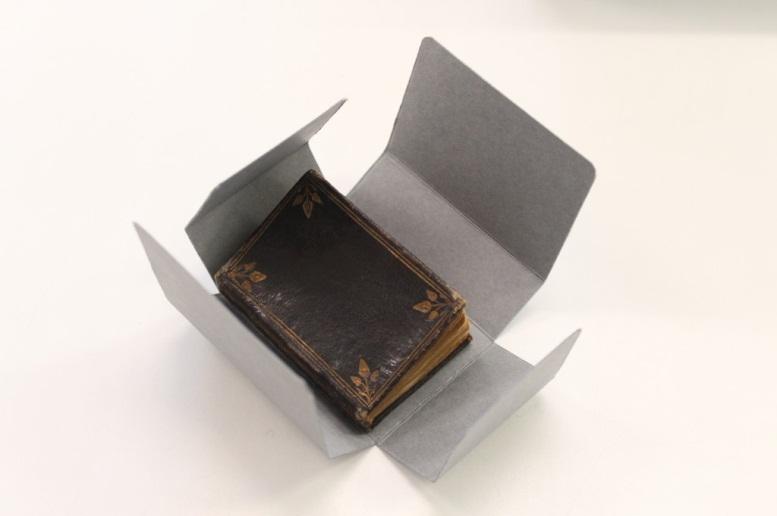
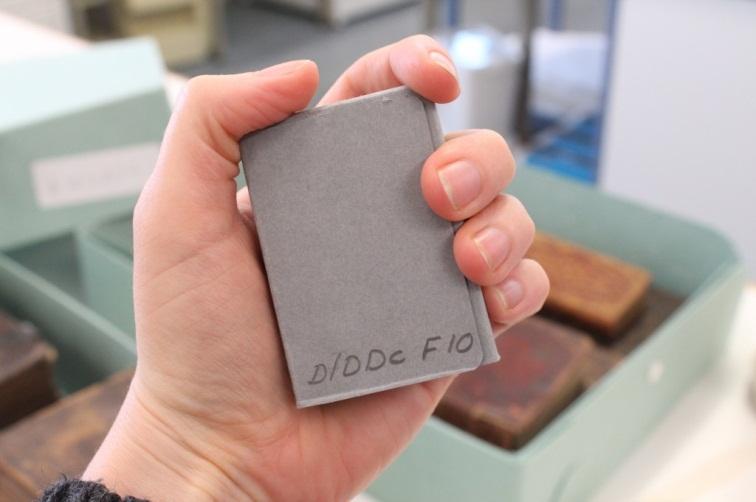
The tiny book now has its own small folder to protect it back in its box amongst larger neighbours.
IMG_5415
IMG_5427

What is the smallest item in your collection? How do you use it with your visitors, and has caring for it presented you with any particular challenges?

Thanks Hannah for this fantastic post! Here's a bit more about our guest contributor:


I am Access and Participation Officer at the Essex Record Office, the storehouse of Essex History. It’s my job to find ways to engage people with our varied collections, from medieval Latin texts to twentieth-century oral history recordings. I grew up in Essex but have only really got to know the place through working at ERO. Essex has a bit of a reputation as a loud, brash, tacky place, but it’s an incredibly varied county, which includes coastal communities, historic market towns, acres and acres of agricultural land, and post-war New Towns. One of my main historical interests in the First World War, so it has been fascinating over the last year or so to explore the First World War documents in our collections and to share the stories that they tell. Out of work I enjoy photography, especially trying to show the more picturesque side of our county. You can see some of the results of my attempts here: http://toomanyphotos.wordpress.com/

Monday, 2 March 2015

#MiniObjects

At The Ministry of Curiosity we like to think that our hearts are the biggest storerooms holding dear to us the love of all museum objects no matter how big, small, fat thin disgusting or cute. We've gotta love them all. 


But there is no doubt the things that really make us coo are those objects that are tiny and especially those that are miniature versions made in adoration of their usually sized counterparts. We know that the British Museum has rooms dedicated to coins and miniatures (the painting kind) but we want to delive a bit deeper into the collections and bring out those mini objects that deserve a bit more praise not only for being adorable but amazing feats of fakery, technology and craftmanship. 

So this week we want to celebrate mini objects by showing you some of our faves and hope you can pull a few out of the stores and highlight their presence on your Collections Online using the hashtag #miniobjects 

To start you off, here's one of our favourites from the Horniman Museum that featured in the museums Object in Focus display in 2013. 


);