Ministry logo

Ministry logo
Showing posts with label National Gallery. Show all posts

Sunday, 24 August 2014

Privatisation? Selfies? A Resignation? What's going on at the National Gallery? #MinistryOpinion

What is going on at the National Gallery? The past weeks have seen the institution fall into disarray that has seen the resignation of Nicholas Penny to selfies in the gallery and an online campaign against privatisation an incredibly unsatisfied work force. 

Penny's resignation last month came after only six years as director and a hugely successful period in the history of the gallery, he has overseen the acquisition of two titan paintings ( Diana and Actaeon and Diana and Callisto) the block buster exhibition of 2011/2012  Leonardo da Vinci: Painter in the Court of Milan and sky rocketing visitor numbers. It's a sad time for the art gang on Trafalgar Square as his resignation followed that of Sandy Nairne director of  NPG. Fortunately both have left for personal reasons and are claiming that they will continue working in academia, nonetheless its a sad loss for the National art collections with the guardian even claiming that 'This looks depressingly like the end of individuality in the museum world.'


Next came the shock decision to allow photography in the permanent gallery spaces - of course excluding those works with complicated copyright or on loan. Whilst I relish in the concept of social media and the masses infiltrating the spaces once occupied by the elite I can't help siding with those cynics stating that the experience of visiting the national art collection will be tarnished by the continued stop and start of people pausing to take photograph without looking at the iconic pieces of art. Having spent a summer working in the numerous shops within the gallery I can tell you that trying to pass through the permenant collection spaces at any speed over zero miles an hour is impossible, already overcrowded with large school and tourist groups the rooms stagnate due to overcrowding less than pondering the works. Surely the stop and start nature of iPhone photography is only going to hold up that experience and prevent those not wanting to photograph from actually experiencing the art? 

Whose going to notice anyway? It looks like the staff of the National Gallery will soon loose their jobs to a cheaper workforce with reports that 600 out of the 800 staff members are due to be privatised in the coming months including those responsible for information requests school bookings  What does this mean? For staff the loss of benefits, a government pension and less options for career progression. For the gallery and public, a transient workforce with less knowledge and expertise. 


Are we seeing the National Gallery transform into a museum of the future? I hope to see positive changes, perhaps a fresh faced and hopefully female appointed by December, photography allowed but to enhance a visit not to replace it, and a strong workforce that feels cared about. 

If you disagree with the privatisation please sign the petition here: https://you.38degrees.org.uk/petitions/no-privatisation-at-national-gallery


 Addendum: we would like to make it clear that we fully support increased access and the use of photography in museums and galleries. Yet we encourage our readers to think critically about the industry, it's future and the decisions of national institutions. In this instance we feel that impending  privatisation of the National Gallery's workforce caused the decision to allow photography, thus promoting questions as will the change in rules reduce the amount of staff in the galleries? How will those visitors who do not wish to take photographs enjoy the space? And how will a gallery already so overcrowded monitor crowds and ensure that those works on loan or with copyright restrictions are not photographed? 
Regardless we do not want to see the staff of a national gallery privatised and urge you to sign the 38 degrees petition. 

Saturday, 26 July 2014

The Ministry Recommends: Making Colour at the National Gallery

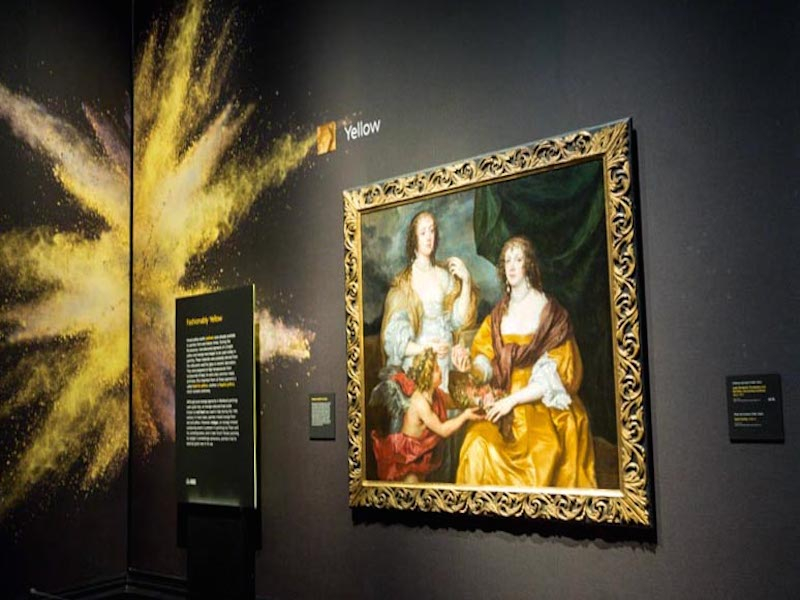
When looking for exhibitions to review, we often try to focus on London's smaller museums and galleries. Of late it seems institutions like the big nationals seem to being doing much of the same old same old. Thankfully we didn't let our preconceptions keep us from visiting the National Gallery's current exhibition Making Colour. We mean it when we say it is one of our favourite exhibitions of the year and an absolute curatorial masterclass of interpretation and design. Sleek, concise, intriguing and informative, Making Colour is exactly what an art exhibition should be.


How do I even start reviewing this exhibition? It would be tempting to take you through room by room pointing out everything that was fascinating or noteworthy. But we'd be here all day. Making Colour is essentially a brilliant idea that makes you look at art differently. What more can you ask for? The rooms are organised by colour and structured by pigment. On one wall you'll see paintings from the 15th century through to the Impressionists who share in common the same pigments, usually displayed alongside the raw product. The concept is simple but eloquent. And the design follows suit.


Black painted walls provide a calm background for you to consider the nuanced colours of the painting. Each room is disrupted by a riot of colour that draws your attention to what you should be focusing on in that space, accompanied by concisely written panels that explore the origins of that pigment. The topic might be chemical is nature, but the emotional aspects of colour are not forgotten. Red for passion, love, rebellion and blood, purpose for luxury and royalty. 


Unlike some recent National Gallery exhibitions, there is plenty of space in the galleries and each painting is carefully chosen to prevent overcrowding. Perhaps most impressively, each room mixes works of art from across the centuries with raw materials, videos, sculpture and textiles. The mixed media enhances the paintings captures your attention. 


With your attention so carefully guided, each painting, which you probably wouldn't have strolled past without a second thought normally, becomes an opportunity for contemplation. In the gallery, visitors stare purposefully at each work- a testament to impeccable pacing and structured on the part of the curators. At a deeper level, each carefully considered artwork adds its own unique story to the message of the exhibition. For example, we learned how the red velvet arms of the dress worn by this sitter were likely made from dyes extracted from the textile of a similar dress.


This painting of the Virgin Mary takes on an additional devotional quality when we learn that the blue paint of her robes was worth more than gold. This artwork hangs next to a film which discusses the harsh reality of lapis lazuli mining in Afghanistan- showing how far we are still willing to go in our quest for the perfect blue.


It doesn't matter if you are a paintings enthusiast, a conservator, or just an art lover, we can guarantee you will walk aways from this exhibition having learned something new. Did you know that Isaac Newton developed the colour wheel in the 1660s? Or that Cezanne was only able to create his bright tropical landscapes because new synthetic paints had been developed? Or that some Dutch still life paintings contain poisonous lilies painted with ruby of arsenic? We are tempted to go back just to have another try and wrapping our mind around the idea of colour. 

Making Colour is on at the National Gallery until the 7th of September: http://www.nationalgallery.org.uk/whats-on/exhibitions/making-colour


Thursday, 22 August 2013

Review: Michael Landy's 'Saint Alive' at the National Gallery

As with most of my regular weekend gallery outings, I had made a plan to see one of London’s most popular exhibitions, in this case the National Gallery’s Vemeer and Music. On the way in, my trusty museum-hopping amigo E noticed the poster for ‘Saints Alive by Michael Landy’. ‘Is that on now?’ I asked incredulously. ‘I’ve never heard of it.’ ‘Oh yes I heard about this, it was recommended to me by someone at work.’ So after a quick tern around the decidedly mediocre Vemeer, we headed into the main building on the hunt for this mysterious exhibition that had apparently been on since May.

It wasn’t too hard to find. Walk in through the main doors and listen for the distant sounds of thumping and crashing. Queuing in the middle of one of the ornate gilded galleries, the crashing of metal on metal is not exactly what you expect to hear in these hallowed halls. But that’s exactly what ‘Saints Alive’ is all about.

Michael Landy has been working with the National Gallery as their artist in residence since 2009. In his time there, he became inspired by the imagery of the martyrs that runs as a theme across so many centuries of art. Specifically he was interested in the idea of them destroyed themselves to save others and lead them into salvation. So how do you get the average gallery visitor to respond with that kind of abstract concept? Well, you make it big, you make it noisy, you make it fun.

Landy’s ‘Saints’ are not the quiet passive figures of the paintings in the gallery- they tear at their faces, they hit themselves, they shudder and swing. Imagery from famous artworks is crossed with kinetic wheels and pulleys to create larger than life de-constructed statues of metal and fibre glass. At each sculpture, there is a foot-pedal which visitors stomp to animate the sculptures while the attendants look on armed with ear plugs against the clanging art works.

There are so many levels you can enjoy the artworks on. Personally, I love the fact that the sculptures are literally destroying themselves. Now that the show has been open for so many months, the sculptures are scratched and tattered, which I think makes them even more interesting.

What’s really important here, aside from the fact that the art is fascinating, is that Landy has actually managed to pull of exactly what an artist in residence is meant to do: engage audiences in a new way with the collections. The artworks are accessible and funny: walking around the gallery no one is standing in quiet contemplation. People are giggling, smiling, stomping on the pedals and pointing as they notice new aspects. I particularly enjoyed St. Lucy’s disembodied eyes giggling wildly on their plate. Visitors are then invited to find the source paintings in the gallery and look at them in a new light.

So well done National Gallery and Michael Landy for such a fun, interesting, irreverent, noisy, challenging installation. I can only hope other nationals in London will take a cue from this! A little birdy tells the Ministry that the Science Museum is developing an exhibition on robots hopefully in the same vein mixing big questions and entertainment to think differently about our collections. More on that shortly…

'Saint's Alive' is a free exhibition at the National Gallery running until November 24th. 
);