Ministry logo

Ministry logo
Showing posts with label photography. Show all posts

Sunday, 14 January 2018

Welcome to Purple Glove Club

Do you get a pang of anxiety every time you see a museum promo shot with white cotton gloves? Do you scream at the TV as the 'historian' dons the expected uniform?  We're got the ultimate solution to all collections management problems (well sort of) - introducing the Purple Glove Club! 


The misrepresentation of collections management goes deep into societal ideas of a museum (you know we love to chat about this!). Nope, we’re not all curators, we don’t know everything about every single thing event in history, we don’t know how valuable your Great Nan's vase is, our great institutions are certainly not dusty (*nods to Mark Carnell) and we definitely don't wear white cotton gloves all the time!  

On TV, in newspapers, social media and even in our own institutions the need to wear those impalpable protectors serves little purpose but to signify to the general public that we are handling something precious. They are the favourite accessory of the PR person or journalist, and all of us have been in those uncomfortable photo shoots in which we are forced to wear the white gloves because 'people like them'. Well, people like them because it's what they are told to like. We are ready to dispel the myth and celebrate a bit of purple nitrile.

First, we start with the basics - why do we even need to wear gloves? Yes, this is a question museum people get asked - can't you just do away with them entirely? Especially if its a TV presenter who wants to handle an object. If you don’t already know then head over to this great E-learning tool from Museum of London website.  Every object is different and while they need to be handled carefully in all instances the approach to handling can be diverse so while most objects need to be handled with gloves some just need a clean pair of careful hands or in some (now rare) cases white cotton gloves can be used. 

       @SRSRenSoc     
What's got our gloves in the twist is a thing we like to call the Mickey Mouse problem - getting our collections management hands into Disney costume ready for a show with pristine white cotton gloves. Predominantly the only time we’ve had to use white gloves is for handling photoshoots – in one job I even had a clean pair in my drawer for such occasions! While contorting yourself into an ‘object handling’ pose is a fake representation of museum work so are the cotton gloves. Collections management is a science and we use the gloves you might expect to see in a laboratory or a hospital. The difference between the stereotype of a frazzled, amateurish, secretive curator and a highly experienced museum collections professional can all be boiled down to the hands (and indeed, that's often all you see in photos of museum workers). 

It took several hours to get this shot 
But what is wrong with white gloves I hear you say? We’ll here’s our top three reasons why they are not always suitable: 


1) Can you feel it yet? The density of cotton makes it a bit more difficult to get your hands around an object without a good grip they can slip straight out of your hands (Remember the first time you broke an object?) And no press photo shoot is improved by the object in question getting smashed.

2) Wanna get dirty – you know how sweaty you get on install? Yep, imagine all of that sweat building up onto an absorbent fabric and coming through onto the object (eww). Plus they tend to look pretty dirty pretty quickly - again, not exactly great for your museum brand. 

3) Hazards bingo! If you think all that sweat can make its way out, what can make its way in? Yep, all of our favourite museum hazards can seep into your pores! It doesn't really matter how short a period you are holding the object for - even if its just for a few photos, it's not something we want to risk our lives over! 

If that’s not enough to make you want to go nitrile then ask your favourite conservator their thoughts – there’s plenty more!
  
But why nitrile?  Well my friend, they are durable, tactile non-absorbant and looks pretty freaking good with any outfit. We feel safe, the objects stay safe, conservators are happy, curators are happy - all that's left to do is spread the word! 

Purple gloves they may make you a bit clam-y but...

They look good with any outfit 

Even when they clash with your hair 
Credit: C John Chase

It took a whole day to rip these bad boys up!
They are super bright and cheerful 

They are tactile and help us do our jobs better

They are durable and protective 

and they bring professional museum work into the twenty-first century!


So are you ready to join the #purplegloveclub? We’re calling for a revolution in museums and to celebrate the wonders that are purple nitrile gloves! The more we can make the representation of these gloves the standard, the sooner we can give the cotton glove conspiracy the boot! Share your photos on insta and twitter and be sure to tag us! 


Tuesday, 16 August 2016

Visions of the Great White South: Cambridge in Bonhams

Last week we went along for a tour of the Polar Museum's pop-up exhibition at Bonhams, Visions of the Great White South. Curated by Charlotte Connolly, the exhibition brings together art and images from the Scott Polar Expedition, alongside contemporary art commissioned by the Scott Polar Research Institute. We live tweeted the tour and now you can get a sneak peak here. The exhibition is only on until this Friday August 19th and we highly recommend a visit! 


From the bustle of Bond Street to the silence of the Pole

We love whenever regional museums get to showcase their collections in London, so of course we had to get down and see what the Polar Museum was doing on Bond Street! Maybe a strange choice of venue for a display of (not for sale) historic images- or so we thought.

Kicking of the tour with curator from - a research institute which also has a historic collection

Actually I didn't really know very much about the Polar Research Institute aside from that they had a museum. It's worth looking up the really interesting work they do - polar research not just a thing from the early twentieth century! 

Exhibition features work from the official artists of the Scott Polar Exhibition inspired by his work Broken Ice


Curator Charlotte Connolly was inspired by this image from the Terra Nova Expedition's official camera artist, Herbert Ponting. Ponting actually created a documentary about the expedition called the Great White Silence. 

Exhibition also includes beautiful water colours by artist and scientist EA Wilson

But Ponting wasn't alone in capturing the Pole- the exhibition also had along watercolour artist and scientist EA Wilson. This image features a very teeny tiny church on top of the outcropping built by the expedition team. 

Herbert Ponting - the camera artist on the expedition, captured everyday life for an explorer at Cape Evans


Ponting was really a 'camera artist' rather than a purely scientific photographer. He also took pictures of everyday life on the expedition, as well as stunning portraits. This one was taken just as this man returned from a push towards the Pole. 

Apparently Captain Scott became quite a good photographer on the expedition - with his work


In the eyes of Captain Scott, it was important that all members of the expedition were trained to be competent scientific photographers. Scott himself took to photography, and the exhibition features a number of images taken by him, including some very early panoramic photos. 

Wilson and Ponting always wanted an exhibition together of their photos and watercolours - finally realised


Exhibition artists Ponting and Wilson had always hoped for a joint exhibition of their works, but Wilson died on the fated journey back from the Pole alongside Scott. Perhaps due to the grief of Wilson's widow, the exhibition never happened. Now some of their works have finally been reunited. 

So why are we in ? Because they sponsor artist in residence who travels to Antarctica


Well the big reveal- we are at Bonhams because they sponsor an artist-in-residence at the Polar Institute! These lucky artists get to travel down to the Pole each year to capture the science of polar exploration through art. These paintings were actually done by Captain Scott's granddaughter!

A closing note on the epic landscapes of Emma Stibbon


The contemporary art portion of the exhibition is really stunning. I thought this was a photograph but its actually a drawing! Amazing to see how the Pole is still an inspiration for generations of artists. 

A fantastic mix of history, science and art we really can't recommend Visions of the Great White South enough! It's free to visit so just pop down to Bonhams anytime this week. There are even tours available this Friday: https://www.eventbrite.co.uk/e/exhibition-tour-visions-of-the-great-white-south-tickets-26825554957


Wednesday, 25 March 2015

Beard @ Somerset House

If you're looking for something a bit more highbrow than Fifty Shades of Grey to lust after this March then perhaps Beard at Somerset House will fill the more acceptable void of popular culture porn. 


Fitting neatly into the Terrace Rooms at Somerset House Beard is just what you'd expect from a portrait photography show with the phenomena of beards as the central theme. There are of course the handsome bearded men like Gavin Turk and Everton goalkeeper Tim Howard thrilling many visitors. However the more unconventional beard is also celebrated with the beautiful British bearded woman Harnaam Kau who has been growing her facial since the age of sixteen due to her polycystic ovaries. 

The photographic prints are interesting and with pastel backgrounds they could almost look like paintings however I was disappointed that there was little information on the printing process and the visitor assistance knew not of it it either. 

The main drive to Mr Elbank’s project was Jimmy Niggles to familiar and incredibly handsome lead image of the campaign that leaked onto social media last year. Niggles a now prominent Australian charity campaigner grew his beard after the loss of a close friend to skin cancer. Niggles claims that he grew his beard with the aim of it becoming a conversation starter, using it as a platform to raise awareness of preventable diseases.  Inspiring photographer Elbank, this story prompted the #Project60 Campaign to raise awareness of Niggles’ Beard Season through social media and since Niggles has been the face much lusted after by beard-lovers. 

Social media is key to this show and its success. You are allowed to photograph the images and it does almost feel as if you have stepped into Elbank’s instagram feed. It is certainly a nicer way to view the portraits but for a show at Somerset House incredibly small and I left wanting to know so much more about the sitters, the photographic processes and the photographer. However, there are some great events on this week - it's last week!


Beard can be seen: 
Daily 10.00-18.00 (last entry 17.15)Terrace Rooms, South WingFree admission


Beards: Art Macabre Death Drawing Special
Wednesday, 25 March 2015, 19.00-21.00
£18.00
Sketch bearded bare models with Art Macabre at a special themed life drawing salon. Inspired by Mr Elbank's exhibition Beard, draw your own stylish bearded portraits as we celebrate the cultural phenomena of the Beard.

Captain Fawcett’s Grooming Parlour Talk
Thursday 26 March 2015, 14.00-14.40
Courtyard Rooms, South Wing, FREE Limited places
If you have been inspired by Beard but are a tad unsure on how to keep your own facial foliage in tip top condition, then why not join us along with the much esteemed Captain Fawcett for an informal chinwag that may go some way to answering your questions whilst offering tips on how to maintain a stiff upper lip regardless. With a battle cry of ‘All hail the hirsute’, Fawcett is the kind of chap you’d want on your side if ever you (and/ or your beard for that matter) were found wanting in the face of a sticky wicket. The Captain will be dispensing his wisdom with characteristic style and panache on all things needful for the well-turned out gent about town. A fine range of Captain Fawcett’s First Class Gentlemen’s Grooming Requisites will be available in the Rizzoli shop throughout the exhibition.

Monday, 3 March 2014

Review: Bailey's Stardust at the National Portrait Gallery

British photography = David Bailey. Fact. The iconic portrait photographer’s work has dominated our view of fashion and culture for the past fifty years and finally a selection of over three-hundred images has arrived at the National Portrait Gallery. Curated by the man himself the exhibitions proves to be an exciting look at the familiar portraits from one of the greatest image-makers. 


If you haven’t heard of David Bailey then you must have spent the past fifty years watching paint dry. His familiar images and cult status have led him to become a household name (my Nan still coos ‘Ohh you’re being such a Bailey’ anytime someone pulls out a camera), and copies of his images adorn living room walls across the country. Famous for his time spent as fashion photographer for British Vogue in the sixties, Bailey is credited alongside photographers and film directors Terrence Donavon and Brian Duffy for helping to capture and create the ‘Swinging London’ phenomenon. 
Jean Shrimpton - Babe

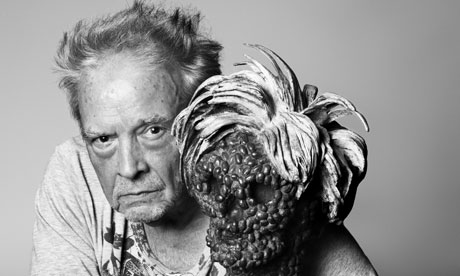
Nonetheless, his self-curated and self-printed exhibition at the National Portrait Gallery provides a broader look into his art. Sorted thematically the numerous rooms allow visitors to quickly explore his familiar work. ‘Fashion Icons and Beauty’ features some of his most recognisable celebrity images and a sculpture titled ‘Dead Andy.’ Made of baked beans and plaster Bailey’s few sculptures provide an entertaining caricature of his good friend Andy Warhol. But the images of the Rolling Stones and Dali show to the stark difference to Bailey’s portraits of ‘unknowns.’ With an almost ethnographic vibe his images of individuals from Sudan, Delhi, Papua New Guinea and Australian Aborigines you begin to see a different in his work as a sensitive photographer and that of an almost paparazzi.
Fashion Icon - Anna Piaggi 


Dead Andy and David
The beauty of his work truly comes together in the final room, with his exploration images of the East End – again almost ethnographic, with stories of hostility and suspicion of him when photographing within the local working men’s club the images are gritty and feel real with scenes of working class girls ready for a night out on the tiles. Some very odd and I suppose artistic curating has gone on here, almost as if there were all of this images he was desperate to put in but couldn’t find room in the other tightly categorised sections. Next to East Enders sits images of Salvador Dali and Andy Warhol and are reminded again of his status as a cult photographer.

Saturday Night with East End ladies.
But with his more recent series ‘Democracy’ towards the close, Bailey sends outwardly shows  that his photography isn’t all about papped celebrities, the normal and absurd sit proudly together. Perhaps the most exciting end to a portrait photography exhibition is the skull series, unusually classified as life work, David Bailey believes skulls are the ultimate form of portraiture and I believe him, as the remains happily pose for their photography surrounded by the very symbol of life - flowers. 

Bailey's Stardust at the National Portrait Gallery reveals  a national icon - a definite see. 

Running until 1st June 2014, tickets cost £16 per person. Find out more here: http://www.npg.org.uk/whatson/bailey/tickets.php or @NPGLondon

Sunday, 16 February 2014

Building a better architecture exhibition: Sensing Spaces at the Royal Academy

For their new Sensing Spaces exhibition the Royal Academy set out to answer the question, can you put architecture in a traditional gallery space? Doing away with any drawings or models, Sensing Spaces is structure, space, light and activity jammed straight into the gilded vaulted ceilings we know and love. The RA has created a playful, immersive exhibition- but does it actually tell us anything new about architecture? The Ministry investigates...


If you’ve ever been to the Summer Exhibition then your memory of the Royal Academy exhibition space is probably a series of 8 or 9 good-sized rooms packed floor to ceiling with artworks. Stripped bare, the RA’s exhibition space becomes a 23,000 square-foot canvas - it’s every curator's wet-dream (or maybe their nightmare). The floor plan is big enough that they have managed to pack in 6 epic-sized installations that finally let architecture be experienced as it’s meant to be – in massive proportions.


Technically you can wander through the exhibition anyway you’d like, but its hard to not find yourself distracted by this wood behemoth, proudly surveying the scene.  Pezo von Ellrichshausen’s installation ‘Blue’ is like a children’s tree house with windy stairs bringing you up above the 'canopy' to really appreciate the beauty of the gallery’s ceiling. I mean really, have you ever looked up at the Royal Academy? Von Ellrichshausen makes sure you do by essentially blocking your view of anything else. A not-so-subtle word of warning from the conservation team- just because you can see the historic features does NOT mean you can touch them.


Each of the architects has brought something incredibly different to their structure. It’s tempting to describe them all in detail- but what would be the fun for you when you visit? Diebedo Francis Kere shows how serious architecture can be fun and creates a honeycomb cave of colours through the gallery (if you've been noticing brightly coloured straws littering Piccadilly tube station of late here's why). Grafton Architects play with light in what feels like the most serious piece of the exhibition. Keno Kuma challenges your idea of what architecture is all-together by creating a delicate softly lit garden of bamboo. By comparison, Li Xiaodong's moon-lit forest seems clunky and awkward (word of advice not for the claustrophobic!)


Any critiques of the individual works aside, does Sensing Spaces actually teach us anything about architecture? As non-experts ourselves, we can't say we left the exhibition understanding anything more about the big questions of art vs. design that the RA are trying to address. The exhibition's core concept is a bit of a double-edged sword conceptually speaking. Focusing on built 1:1 scale installations removes need to interpret drawings and models - visitors use their senses to feel the quality of the exhibit's spaces. Presumably this is what the title of the exhibition refers to - contrasting with the 'typical' architecture exhibition where we're assisted in imagining spaces (although the V&A did something similar with 1:1 structures a few years back). However, without assistance from explanatory drawings the installations appear to be just that- built space art installations like you can see in almost any white cube gallery. This begs the question, should something like design even be displayed in this way? Or does it take away that technical, practical element which differentiates it from art? We personally would have loved to hear more from the architects about what they wanted to achieve in the space- much in the same way that interpretation brings a deeper understanding of art in any context. To label or not to label- it is a big question in the art world anyway. Would this additional information have detracted from the experience of the installations in the space? Its a big question that someone undoubtably spent a year's worth of sleepless nights considering. 


The curators do seem to have anticipated this critique - a handful of iPads in the entrance contain design images for the curious. Yet without some specialist knowledge they contain little explanatory power and seem to be mostly there to be appreciated aesthetically.


Whether or not it says something insightful about the intersection of art and design- we can absolutely guarantee you are going to enjoy yourself. At the Ministry we strongly believe in engaging visitors with art done in a way that's light-hearted and accessible. Sensing Spaces provides opportunities to play, sit, chat and wonder in the way that all good exhibitions should. Not to mention that crucial factor (always high on the Ministry's list)- you can experience the whole thing through the lens of your camera phone. To be honest, why bother creating immersive, awe-inspiring, interactive spaces and then not let the public respond in their favourite way: photography. Whether its artsy shots through the moonlit forest, silly selfies amongst the neon-coloured straws or just trying to capture the light in the galleries- we are sure there is plenty of evidence on Instagram that attests to the exhibition's popularity. Like Lightshow at the Hayward Gallery last year, what Sensing Spaces does best is encourage its audience to engage in their own way. 


At £15 a ticket, Sensing Spaces is pretty pricey. But for the touching, playing and exploring you get we’d say it’s definitely worth it. Its art that packs a punch, it’s design with a sense of humour, it’s the Royal Academy like you haven’t seen before. We also have to mention, almost more impressive than the exhibition itself is the absolutely tremendous events programme the RA has built up around it. Explore the gallery enhanced by poetry (7th March), music (10th March) and DJ sets (21st February). You can even learn how to write about architecture (31st of March), hear more from the experts or get your yoga on (30 March). You have until the 6th of April to make the world of Sensing Spaces your own- so what are you waiting for? 

Sensing Spaces: Architecture Re-imagined is on at the Royal Academy until the 6th of April. http://www.royalacademy.org.uk/exhibitions/sensingspaces/

Sunday, 17 November 2013

Out of this World: Astronomy Photographer of the Year 2013

Autumn brings the new exhibition season and across the city blockbuster shows pull in the windswept crowds but one annual autumnal exhibition often gets overlooked. The Astronomy Photographer of the Year exhibition sits in a small room of the Royal Observatory, Greenwich, you don’t need to queue or visit the gift shop just enjoy the powerful images emphasizing our position as a tiny fleck in the huge universe.


2012 Overall and Deep Space Winner: Martin Pugh with 'The Whirlpool Galaxy'
The Competition has been running a mere five years and every summer the Royal Observatory, Greenwich encourages submissions from across the world, with the only criteria: an image of the skies shot from earth. Across the few years amazing images have been produced by the amateur photographer to the more professional, and competitors can win one of four categories: Earth and Space, Our Solar System, Deep Space, Young Astronomy Photographer of the Year (For entrants under sixteen.)  


This year’s entries are pretty, powerful and highlight why this is my favourite annual photography competition - the images are mind blowing and actually freak me out with their intensity. Astronomy is bloody amazing, the images are singularly beautiful and combined fierce, looking at another galaxy, another perspective on the moon how can you not be impressed?

Although the location of the exhibition isn't the best, somehow the small room and it’s use as a thoroughfare works well. It excitably grabs those about to enter the planetarium to see more awesome astronomy and inspires those exiting with some excellent amateur shots. The exhibition space is dramatically improved by the voices and visuals of the photographers explaining their work and motivation on a projected screen.

My favourite shot is ‘Ring Of Fire Sequence’ by Jiao Hao (Singapore) his work shows the annual eclipse as sunset during which the sun remains visible and Hao explains that the ‘view can be as stunning as a total eclipse’

Highly-commended Astronomy Photograph of the Year 2013


The Young astronomy photography of the years entrants are equally as impressive the winner of the category and at only fourteen years old Jacob Marche (USA) captures the beauty, dust and gas  of The Milky Way Galaxy’

Young Astronomer of the Year:
The Milky Way Galaxy by Jacob Marchio (USA), aged 14
Of course without a degree in astrophysics I’m unable to tell you much more about the content of the pictures, but the beauty of our galaxy and many others provides a reality check for me and a space to enjoy the nature out of this world. Listen to these professionals  and see some more mind blowing images…


 If you want to feel small and insignificant then head to the Royal Observatory, visit the exhibition and you must watch at least one of the planetarium shows where you can lie back look at the stars and listen to the informative and soothing sounds of the Royal Astronomers.

Astronomy Photgrapher of the Year 2013 will be displayed in Flamsteed House, Royal Observatory Greenwich until Feburary 2013. 
And find out about Planetarium Shows here: http://www.rmg.co.uk/whats-on/planetarium-shows/
);