Ministry logo

Ministry logo
Showing posts with label National Portrait Gallery. Show all posts

Saturday, 22 March 2014

And so it begins: The Great War in Portraits at the National Portrait Gallery

We are now a few months in to 2014 and the National Portrait Gallery has opened London’s first major exhibition for the Centenary of the First World War. With many more sure to come, particularly in the autumn, the Ministry ponders the museumification of conflict and war as a blockbuster.

Torso in Metal from 'The Rock Drill' 
by Sir Jacob Epstein, 1913 – 14. Tate.
It seems everyone is planning their First World War exhibition to open over the next few months. It's one hundred years since the beginning of the conflict that arguably shaped modern life as we know it. Museums are physical repositories of history, so surely it is their job to serve as sites of remembrance for major events? And yet, the scramble to put on the biggest and best First World War show seems somehow insensitive. Museum stores are trawled for early twentieth century objects, curators sweating over whether this or that is really from the right era or really from the 1930s. How can our collections be a part of the Centenary? The pitfalls of commemorative exhibitions are well known: glorification rather than critical consideration, forcing your collection to fit a narrative that’s just not there, originality swapped for public appeal. It would be easy to celebrate the heroic and the tragic while forgetting the human story. Is it even possible to strike the right balance between respect, historical accuracy, originality and national pride? 

Reproduction German poster, copyright Imperial War Museum
But fear not, the National Portrait Gallery’s exhibition does an excellent job of presenting a critical view of the First World War that fits well within the remit of it’s collections. Nothing about the Great War in Portraits feels forced. Indeed, the curatorial teams have managed to use the conflict as an opportunity to really question the entire idea of portraiture itself. The exhibition is laid out chronologically, and while this might seem like not a particularly original approach, what it does is show the rapid descent of portrait art from celebratory to critical. The first room is full of royals in their regalia- a stoic reminder of the way conflict had always been fought up to this point. By the time you move into the second room, it becomes clear that the Great War wasn’t what anyone had expected. Commissioned portraits of famous generals and valiant troops, fade quickly into the challenging works of Christopher Nevinson and other artists sent to the Front. The average military portrait we are so used to seeing suddenly takes on the darker tones of propaganda when displayed next to the suffering of the troops they are commanding.

The Valiant and Damned, copyright the National Portrait Gallery
One of the most interesting features of the exhibition is the wall of photographs titled, ‘the Valiant and the Damned’. The wall-sized collage seems a little jarring against the rooms of traditional paintings particularly when photography hasn’t featured in the rest of the exhibition. However, the display serves both to integrate the Gallery’s substantial photographic archive, as well as to try and incorporate something of the human voice into the exhibition. The photographs are accompanied by a booklet in which you can read more about each sitter’s experience of the First World War. Finally it’s not just commissioned artists and generals represented but soldiers, contentious objectors, doctors, nurses and poets. The individual voice is something museums are going to be focused on quite heavily in the next round of exhibitions. We like the NPG’s idea, although it works much better as a website interactive than a static gallery display. 

Gassed and Wounded by Eric Kennington, copyright Imperial War Museum
The largest central room is by far the most poignant. Themed around medical treatment in the War, the paintings by William Orpen and Eric Kennington turn increasingly dark as they were experiencing the atrocities of war. Doctors and surgeons are well representing, struggling to cope with a new mechanized warfare producing injuries never before seen. Henry Tonk’s pastels of facial injuries shown alongside case notes are a particular draw. The pained faces of the wounded in these images seem to morph naturally into the Expressionist works of Kitchener. I can’t recall seeing an exhibition that ties the development of art history so well into political and human circumstance.


Other museums take note- the NPG has set the bar high for First World War remembrance. There is no ounce of glorification to be found in the displays. In fact, you walk away not being able to look at traditional military portraits quite in the same way. The Centenary of the War should be an opportunity to rethink your own collections, rather than cashing in on public interest. With some of the most famous Great War portraits all in one place, the NPG provides big names without compromising on its critical perspective.

The Great War in Portraits is free and on at the NPG until the 15th of June. http://www.npg.org.uk/whatson/firstworldwarcentenary/exhibition/about.php

Monday, 3 March 2014

Review: Bailey's Stardust at the National Portrait Gallery

British photography = David Bailey. Fact. The iconic portrait photographer’s work has dominated our view of fashion and culture for the past fifty years and finally a selection of over three-hundred images has arrived at the National Portrait Gallery. Curated by the man himself the exhibitions proves to be an exciting look at the familiar portraits from one of the greatest image-makers. 


If you haven’t heard of David Bailey then you must have spent the past fifty years watching paint dry. His familiar images and cult status have led him to become a household name (my Nan still coos ‘Ohh you’re being such a Bailey’ anytime someone pulls out a camera), and copies of his images adorn living room walls across the country. Famous for his time spent as fashion photographer for British Vogue in the sixties, Bailey is credited alongside photographers and film directors Terrence Donavon and Brian Duffy for helping to capture and create the ‘Swinging London’ phenomenon. 
Jean Shrimpton - Babe

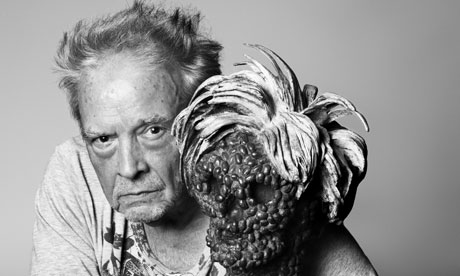
Nonetheless, his self-curated and self-printed exhibition at the National Portrait Gallery provides a broader look into his art. Sorted thematically the numerous rooms allow visitors to quickly explore his familiar work. ‘Fashion Icons and Beauty’ features some of his most recognisable celebrity images and a sculpture titled ‘Dead Andy.’ Made of baked beans and plaster Bailey’s few sculptures provide an entertaining caricature of his good friend Andy Warhol. But the images of the Rolling Stones and Dali show to the stark difference to Bailey’s portraits of ‘unknowns.’ With an almost ethnographic vibe his images of individuals from Sudan, Delhi, Papua New Guinea and Australian Aborigines you begin to see a different in his work as a sensitive photographer and that of an almost paparazzi.
Fashion Icon - Anna Piaggi 


Dead Andy and David
The beauty of his work truly comes together in the final room, with his exploration images of the East End – again almost ethnographic, with stories of hostility and suspicion of him when photographing within the local working men’s club the images are gritty and feel real with scenes of working class girls ready for a night out on the tiles. Some very odd and I suppose artistic curating has gone on here, almost as if there were all of this images he was desperate to put in but couldn’t find room in the other tightly categorised sections. Next to East Enders sits images of Salvador Dali and Andy Warhol and are reminded again of his status as a cult photographer.

Saturday Night with East End ladies.
But with his more recent series ‘Democracy’ towards the close, Bailey sends outwardly shows  that his photography isn’t all about papped celebrities, the normal and absurd sit proudly together. Perhaps the most exciting end to a portrait photography exhibition is the skull series, unusually classified as life work, David Bailey believes skulls are the ultimate form of portraiture and I believe him, as the remains happily pose for their photography surrounded by the very symbol of life - flowers. 

Bailey's Stardust at the National Portrait Gallery reveals  a national icon - a definite see. 

Running until 1st June 2014, tickets cost £16 per person. Find out more here: http://www.npg.org.uk/whatson/bailey/tickets.php or @NPGLondon

Saturday, 23 March 2013

The Ministry's Gift Shop Guide.

Here at The Ministry we love the gift shop just as much as the exhibition. How else can you feel like a collector on a Museum professionals salary? Well, we have found ten of the best pieces in London Museum's Gift Shops for under £30


Thanks to That Fall by Naomi Campbell in the 90's
I'm far too scared to ever wear platforms this high but I
can still ogle Viv Westwood's beautiful shoes with
this postcard 
70p @  V&A


Who doesn't want a giant pen lid as a desk tidy.
At least you can't choke on it.
£11.95 @ Design Museum
It looks like she needs a cuddle. 
Grab this cushion cover for only £15 from Tate
Make a mistake and let David Bowie
correct it with this rubber
£1.50 V&A

Every Cabinet of Curiosity needs an indication that
you have been somewhere or are planning to travel.
This book is the perfect starting point and its colourful!
'Folio Society: What are the Seven Wonders of the World'
£24.99 @ British Museum
Isn't Vintage style apothecary a darling?
 For only £10 @ Museum of London
you pretend you're a medical collector like Henry Wellcome.
It couldn't get any cuter! Influenced by Ice Age Art
Exhibition the British Museum have these Mamommoth Tagua
Necklaces for £24.99. And it's fairtrade.


It's a Lego Lunchbox!
£10 @ Science Museum
Ermmm, so I found this 'Poo in a Box'
 @ Natural History Museum for £5
It's basically a great fertile starter to grow the sunflower seeds provided.


We all need a momento like this so we can ask ourselves
What Would Darwin Do?
This 11cm high Charles Darwin Bust is only
£18.00 from @ National Portrait Gallery


Sunday, 6 January 2013

Exhibition Review: The Lost Prince at the National Portrait Gallery

The Lost Prince: The Life and Death of Henry Stuart does pretty much what is says on the tin: tells the story of the (very brief) life of Henry Stuart, Prince of Wales (1594-1612) through portraits of himself, his family and his court. If you are like me and have only a very shaky grasp on this era in British history, Henry Stuart is not in fact one of the princes in the tower, but the son of King James I, successor to Elizabeth I. 


I can't say it's the most inventive exhibition I've ever seen, but what is really so wrong with a few rooms of impressive paintings? The larger than life scenes of early 17th century royalty are beautifully conserved in all their regal glory. I find the people quite sad looking, all pale and fragile but that’s historical context for you. 

What really shines about this exhibition is not so much the portraiture but the objects which are shown alongside them. The exhibition includes a copy book by the young Prince himself showing him improving his handwriting, complete with disparaging notes in Latin by Henry’s tutor commenting on his childish script (which looked just fine to me). The Royal Armouries have lent two ornate suits of armour worn by the young Prince. They stand barely 5 feet tall, and somehow really humanize Prince Henry who suddenly seems less like the larger than life figure in his portraits, and more like a little boy playing at king.

Undoubtably my two favourite objects are located in the last room which explore Prince Henry’s early death at 18. One is a wooden effigy of the Prince which would have been laid out for mourners after the body was buried. Although it originally included luxurious robes and life-like wax hands and a head, now all that remains are some roughly-human shaped blocks of wood. Amazing how such basic material can be embedded with such meaning so as to become the body of dead child. It’s dilapidated state makes it even more haunting, displayed in a perspex case/coffin. 

You probably could have guessed that the highlight of the exhibition for me was the autopsy notes made after Prince Henry’s death. When such a seemingly healthy young man dies so suddenly, its no supririse that his personal physician was the one to blame, some even going so far as to suggest he was poisoned by his own doctor. The autopsy report is written in English so any curious visitor with an eye for 17th century script can read for themselves about the clear liquid found in the Prince’s brain, or the blackened state of his lungs. The details provided by the doctor’s notes and the autopsy report have allowed modern doctors to diagnose the Prince with typhoid fever.

Overall, it’s a very enjoyable if old fashioned exhibition. If you are a fan of British dynastic history, then get down to the National Portrait Gallery quickly before the exhibition closes on the 13th of January!

The Lost Prince: The Life and Death of Henry Stuart is at the National Portrait Gallery until the 13th of January. http://www.npg.org.uk/whatson/the-lost-prince-the-life-and-death-of-henry-stuart/exhibition.php
);